
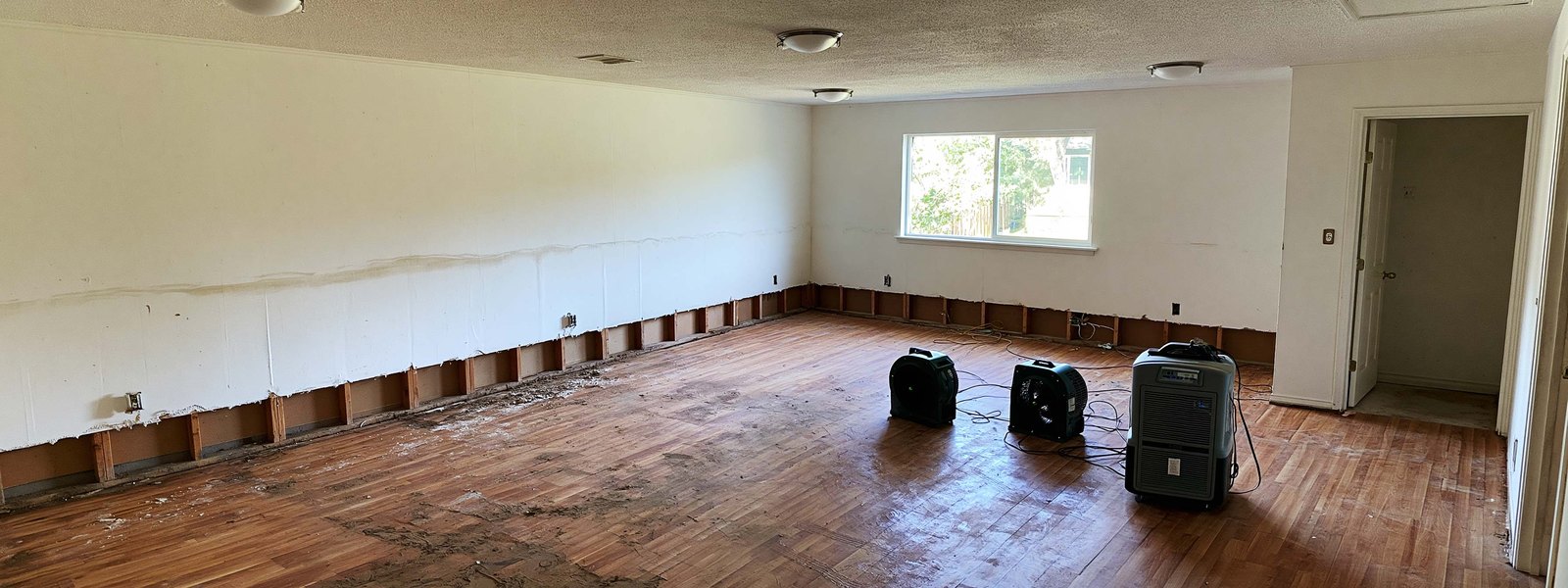
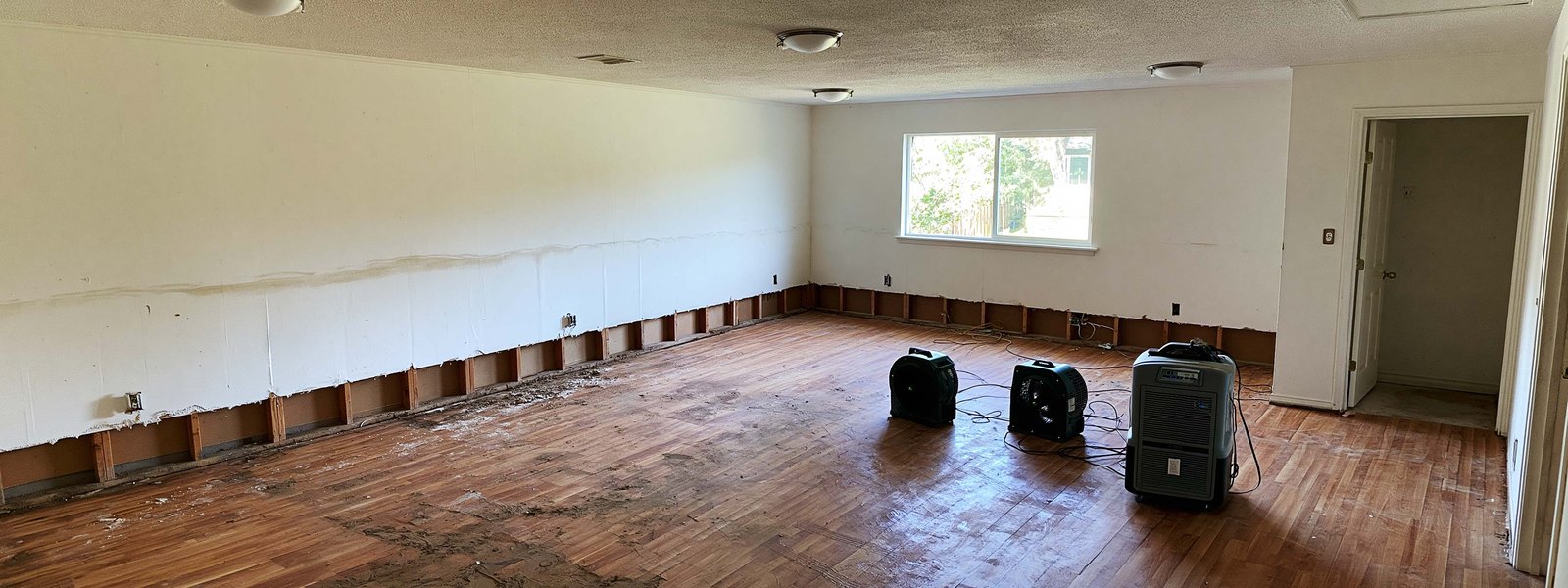
A room part way through drying out, the lower wall cut back to the studs with air movers running on the floor

Water Damage Drywall Repair in Sacramento, CA

The brown ring on your ceiling is the last part of this job, not the first. What matters is whether anything up there is still wet.

An emptied room after a leak, the bottom two feet of wall cut away to expose the studs, two air movers and a dehumidifier running

The Water Comes First, and Then We Take Over

If you don't yet know where the water came from, don't let anybody close that wall, Sacramento Expert Drywall included. A surface closed over something still wet looks perfect for about three weeks and then costs you the job again, plus whatever grew in the meantime.

Push your fingertips into the edge of the mark. If it gives, it's still holding water and this is urgent. If it's firm and dry and has been there since a storm two winters ago, it's a stain rather than damage, and you have time to think about it.

Once the source is dealt with, water damage drywall repair in Sacramento is a straightforward piece of work with one hard rule attached: nothing gets closed up until a meter says it is dry. We'll not skip that step, even on the days you want us to.

What the Mark on Your Ceiling Is Telling You

A water stain is a map of where the water sat, not of where it came in. Water runs along the top of a surface until it finds somewhere to soak through, so the mark can be several feet from the source and often is. That's the most useful thing we can tell you before anything gets opened up.

A ring with a hard edge is old. A soft one is live.

A sharp brown outline means it dried where it stopped, months ago or longer. A soft, spreading edge with no clear line means it is still moving. Rings inside rings mean it has happened more than once, in more than one event, and a yellow tint that keeps coming back through fresh paint means there is still a supply.

Two more are worth knowing. A bulge means the material is saturated and holding weight it was never meant to. And a stain that only appears after heavy rain points at your roof or your flashing, not at a plumbing leak.

The meter settles it in thirty seconds

We take a moisture reading at your mark and then out into the dry surface around it, and the difference between those two figures is the whole conversation. It tells us how far the wet area runs, which is almost never where the discoloration ends. That's how your job gets scoped honestly instead of generously.

The Checks That Come First

Whether your leak has been found and stopped, because nothing else matters until it has
How the material feels under light pressure at the edge of the mark
What a moisture reading says at the mark, and what it says a foot away from it
What's directly above it: a bathroom, a roof line, a supply line or an appliance
Whether it has happened before, which the rings will usually tell us
How long your wall has been wet, since that decides whether it dries or comes out

Dry It, Then Close It. In That Order.

This is where corners get cut in this trade, and it's invisible until it is expensive. A surface that's closed and finished over a damp cavity gives you a beautiful room and a problem you can't see.

A contractor setting up an air mover beside a wall opened back to the studs, dehumidifier running

How long the dry-out takes, honestly

Two or three days with air moving through it is typical for a contained area, and longer if the material is thick or the space is closed in. Leaving equipment running an extra day is cheaper for you than opening the wall a second time. It's a long day with your kitchen open, and it's the version that only happens once.

Sacramento makes this both easier and harder than it sounds. Our summers are dry enough that your open wall gives up its water quickly. Winter is the opposite: weeks of low overcast and high humidity with nowhere for the moisture to go, and a January dry-out takes noticeably longer than a July one.

Where mold actually comes into it

Wet material left closed up long enough grows mold, and the timeline people quote is short. That's the real argument for opening your wall rather than painting over it, and it's not a scare tactic we invented to sell you a bigger job.

If it's already established and the area is significant, that's a remediation contractor's work and not ours, and we'll tell you so plainly. What we do is come back in behind them and rebuild your surface properly.

What Decides Your Price

The size of the mark isn't the size of the job. What decides your price is how far the wet area actually runs, which the meter finds, and what has to come out to get to it.

Ceilings cost more than walls because the work is overhead and slower. Anything that has to be removed and put back, like trim or a light fitting, adds time. And a bathroom or a kitchen with tile and cabinets in the way is a different day than an open wall in a bedroom.

The West Sacramento Question, and the Delta One

Where your house sits changes what we look for. Two things about this valley decide it.

Delta humidity is why a January job takes longer than a July one

The Delta breeze brings damp air up the valley in the evenings, and a house closed up all summer holds more of it than you would expect. It rarely does damage on its own. What it does is slow every dry-out down and keep a marginal area marginal, which is exactly where somebody decides it's dry enough and closes your wall anyway.

Living behind a levee isn't the same as living on high ground

West Sacramento and the low ground along the rivers have a long history with flood water, and the levee system is why most of it stays out. What that means for your house is practical, not dramatic: in those neighborhoods we look low as well as high, because damage starting at floor level behaves nothing like damage starting at the roof.

What we look for on lower ground

  • Marks on your wall that begin at the baseline and travel upward, never down from above
  • Material that has wicked water up several inches and dried hard
  • Signs of an earlier event at the same level, which the paint layers usually record
  • Whether the wet line runs the length of your wall or sits in one place
There's a brown mark on my ceiling. Is it still wet?

Press gently at the edge with your fingertips. Firm and dry usually means an old event and a cosmetic fix. Soft, spongy, or a mark that has grown since you first noticed it means it is live, and the water needs finding before anybody touches the surface.

Do you find the leak as well?

Not usually, and we'll tell you straight if that's what you need. We can often tell what kind of source it looks like from where the mark sits and how it behaves, which narrows down who to call next. Once it's stopped, the rebuild is ours.

Can you just paint over a water stain?

Sometimes, if the material behind it is genuinely dry and sound. A stain-blocking primer holds back the discoloration that would otherwise keep coming through your paint. What paint can't do is fix material that has gone soft or begun to rot, and painting over that is how a small job becomes a rebuild.

How much of my wall has to come out?

As much of your wall as reads wet on the meter, and no more. Where the material has gone soft we cut back to the stud past the wet line, so what goes back is fixed to something dry and solid. Nobody benefits from taking out more than that, least of all us on the day.

Should I take photos before you start?

Yes, from the doorway and up close, before anything is removed. Whatever you decide to do about a claim, a record of how it looked beforehand costs you nothing and takes two minutes.

How long before the room is usable again?

Usually a few days of drying with air moving, then a day for the rebuild and the finish work after that. In the middle of a wet Sacramento winter, add time to the drying rather than the building. You'll know that at the start rather than on the third morning.

Ceiling Repair

The structural side of the same room, when it's failing and not wet.

Read more →

Drywall Repair

Walls opening up for reasons that have nothing to do with water.

Read more →

Texture Matching

Bringing the rebuilt area back into line with what surrounds it.

Read more →

Drywall Patching

Smaller, known damage that only needs closing and finishing.

Read more →

West Sacramento

Low ground behind the levee, where we look at the baseline first.

Read more →

Elk Grove

Newer stock, where supply lines and appliances are the usual story.

Read more →
A laundry room with folded towels and a fern on the windowsill, everything dry and settled

Get Your FREE Estimate

If it's still wet, call us now. If it dried out weeks ago, whenever suits you. Free either way.

Your wall comes back dry, and stays that way.

Call Us Now! 916-584-9660